SOLD OUT
BECKETT | CARSON | GLASS
LECTURE ON THE HISTORY
OF SKYWRITING
QUAD | GLASSWORKS
Anne Carson and Robert Currie, readers
MONDAY, NOVEMBER 2, 2026 | 8 PM
ZIPPER HALL at the COLBURN SCHOOL
200 S GRAND AVE, LOS ANGELES, CA 90012
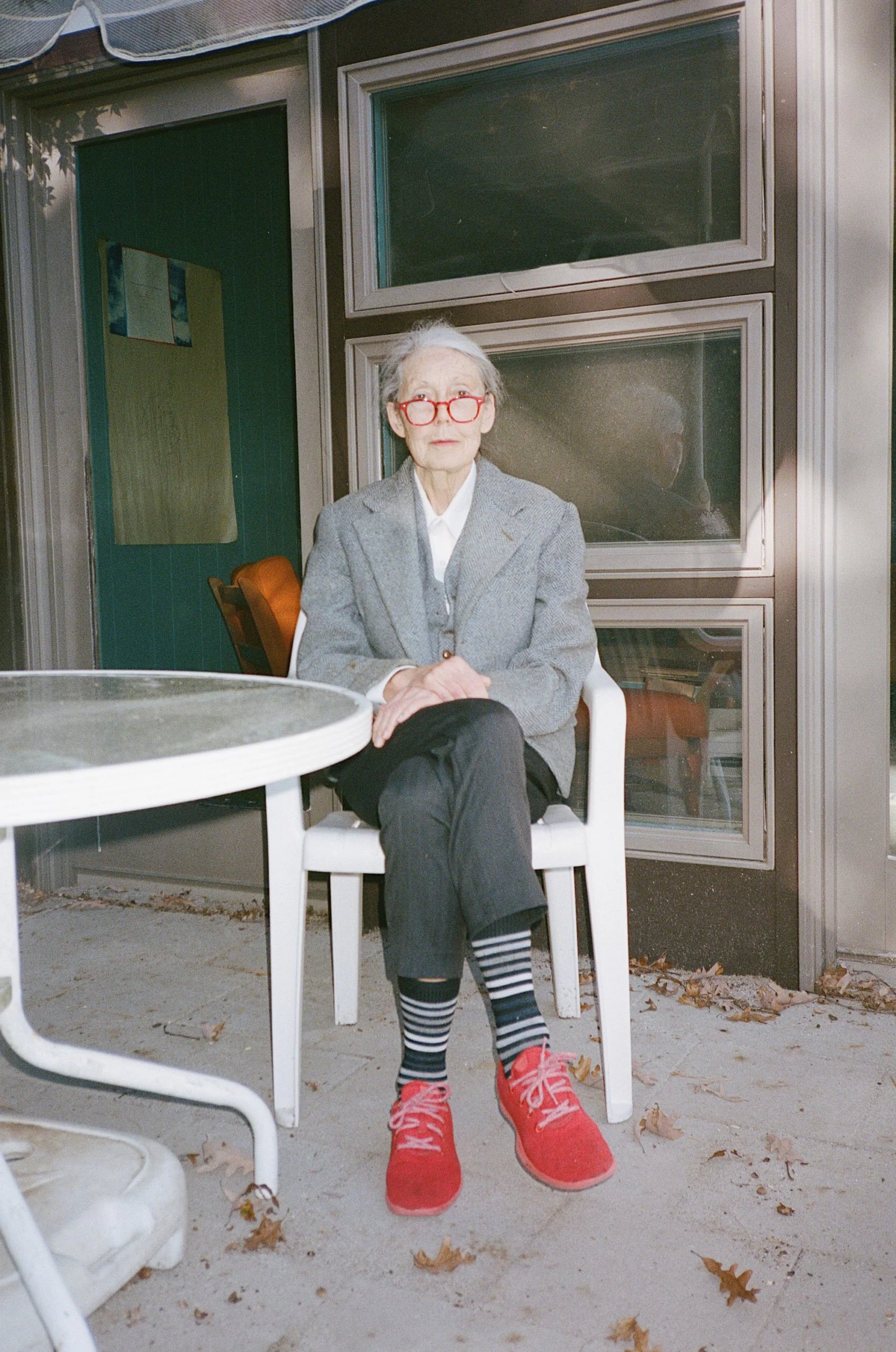
Photo: Anne Carson for Interview Magazine.
Photograph by Christopher Sherman.
PROGRAM
Samuel BECKETT – Quad I (1981)
Anne CARSON - Lecture on the History of Skywriting (2016)
::: intermission (“100,000 years”) :::
Samuel BECKETT - Quad II (1981)
Philip GLASS - Glassworks (1981)
(Music for SKYWRITING by Eyvind Kang and Jessika Kenney)
ARTISTS
Anne CARSON, reader (Skywriting)
Robert CURRIE, reader (Skywriting)
Eyvind KANG, viola d’amore (Skywriting)
Jessika KENNEY, vocals (Skywriting)
Mahfuz SULTAN, director (Quad)
Josh JOHNSON, choreographer (Quad)
Asma MAROOF, musical direction (Quad)
ECHOI, musicians (Glassworks)
Jonathan HEPFER, conductor (Glassworks)
ABOUT THE PROJECT
In her Lecture on the History of Skywriting, poet Anne Carson recounts the creation of the universe from the point of view of the sky itself; Carson and Robert Currie join us as readers for this rare performance, accompanied by an original score by Eyvind Kang and Jessika Kenney. Samuel Beckett’s Quad (1981) – an enigmatic television “ballet” for four cloaked figures endlessly entering and exiting an illuminated square – is realized in a new version directed by Mahfuz Sultan. Beckett was also a formative influence on the young Philip Glass, whose early experiments writing music for the theater helped give rise to the radically repetitive language that would become unmistakably his own. The evening culminates in Glass’s luminous 1981 Glassworks for chamber ensemble: six interconnected movements tracing a great musical circle, arriving finally at precisely the place where they began.
BIOS
-
Anne Carson was born in Toronto on June 21, 1950. With the help of a high school Latin instructor, she learned ancient Greek, which contributed to her continuing interest in classical and Hellenic literature. Carson attended St. Michael’s College at the University of Toronto and, despite leaving twice, received her BA in 1974, her MA in 1975, and her PhD in 1981. She also studied Greek metrics for a year at the University of St. Andrews in Scotland.
Since bursting onto the international poetry scene in 1987 with her long poem “Kinds of Water,” Carson has published numerous books of poetry, including Wrong Norma (New Directions, 2024), a finalist for the National Book Award and winner of the National Books Critics Circle Award; Float (Alfred A. Knopf, 2016); Red Doc> (Alfred A. Knopf, 2013); The Beauty of the Husband: A Fictional Essay in 29 Tangos (Alfred A. Knopf, 2001), winner of the T. S. Eliot Prize for Poetry; Autobiography of Red (Alfred A. Knopf, 1998); and Short Talks (Brick Books, 1992).
Also a classics scholar, Carson is the translator of Electra (Oxford University Press, 2001); If Not, Winter: Fragments of Sappho (Knopf, 2002); and An Oresteia (Faber and Faber, 2009), among other works. She is also the author of Eros the Bittersweet (Princeton University Press, 1986).
Reviewers have praised the range of Carson’s verse, consistently describing her poetry as inventive, visionary, and highly unique. Scholars, such as Roger Gilbert, often discuss the influence of her academic history. Gilbert has noted, “unlike many academic poets she deploys her scholarly voice as a dramatic instrument whose expressive power lies partly in its fragility.”
Carson’s awards and honors include the Lannan Literary Award, the Pushcart Prize, the Griffin Poetry Prize, a Guggenheim Fellowship, and the MacArthur Fellowship. She was also the Anna-Maria Kellen Fellow at the American Academy in Berlin.
Carson was the director of graduate studies in classics at McGill University and taught at Princeton University from 1980–87. She has also taught classical languages and literature at Emory University, California College of the Arts, the University of Michigan, and the University of California, Berkeley. She currently lives in Iceland.
-
Samuel Beckett (1906-1989), one of the leading literary and dramatic figures of the twentieth century, was born in Foxrock, Ireland and attended Trinity University in Dublin. In 1928, he visited Paris for the first time and fell in with a number of avant-garde writers and artists, including James Joyce. In 1937, he settled in Paris permanently.
Beckett wrote in both English and French, though his best-known works are mostly in the latter language. A prolific writer of novels, short stories, and poetry, he is remembered principally for his works for the theater, which belong to the tradition of the Theater of the Absurd and are characterized by their minimalist approach, stripping drama to its barest elements. In 1969, Beckett was awarded the Nobel Prize in Literature and commended for having “transformed the destitution of man into his exaltation.” Beckett died in Paris in 1989.
At the age of seventy-six he said: “With diminished concentration, loss of memory, obscured intelligence… the more chance there is for saying something closest to what one really is. Even though everything seems inexpressible, there remains the need to express. A child needs to make a sand castle even though it makes no sense. In old age, with only a few grains of sand, one has the greatest possibility.” (from Playwrights at Work, ed. by George Plimpton, 2000)
-
Through his operas, his symphonies, his compositions for his own ensemble, and his wide-ranging collaborations, Philip Glass has had an extraordinary and unprecedented impact upon the musical and intellectual life of his times.
The operas – “Einstein on the Beach,” “Satyagraha,” “Akhnaten,” and “The Voyage,” among many others – play throughout the world’s leading houses, and rarely to an empty seat. Glass has written music for experimental theater and for Academy Award-winning motion pictures such as “The Hours” and Martin Scorsese’s “Kundun,” while “Koyaanisqatsi,” his initial filmic landscape with Godfrey Reggio and the Philip Glass Ensemble, may be the most radical and influential mating of sound and vision since “Fantasia.” His associations, personal and professional, with leading rock, pop and world music artists date back to the 1960s, including the beginning of his collaborative relationship with artist Robert Wilson. Indeed, Glass is the first composer to win a wide, multi-generational audience in the opera house, the concert hall, the dance world, in film and in popular music – simultaneously.
He was born in 1937 and grew up in Baltimore. He studied at the University of Chicago, the Juilliard School and in Aspen with Darius Milhaud. Finding himself dissatisfied with much of what then passed for modern music, he moved to Europe, where he studied with the legendary pedagogue Nadia Boulanger (who also taught Aaron Copland , Virgil Thomson and Quincy Jones) and worked closely with the sitar virtuoso and composer Ravi Shankar. He returned to New York in 1967 and formed the Philip Glass Ensemble – seven musicians playing keyboards and a variety of woodwinds, amplified and fed through a mixer.
The new musical style that Glass was evolving was eventually dubbed “minimalism.” Glass himself never liked the term and preferred to speak of himself as a composer of “music with repetitive structures.” Much of his early work was based on the extended reiteration of brief, elegant melodic fragments that wove in and out of an aural tapestry. Or, to put it another way, it immersed a listener in a sort of sonic weather that twists, turns, surrounds, develops.
There has been nothing “minimalist” about his output. Glass has composed more than thirty operas, large and small; fourteen symphonies, thirteen concertos; soundtracks to films ranging from new scores for the stylized classics of Jean Cocteau to Errol Morris’s documentary about former defense secretary Robert McNamara; nine string quartets; a growing body of work for solo piano and organ. He has collaborated with Allen Ginsberg, David Bowie, Paul Simon, Linda Ronstadt, Yo-Yo Ma, Leonard Cohen, and Doris Lessing, among many others.
-
-
Multi-faceted electronic musician Asma Maroof is driven by collaboration, experimentation, and sonic dualities that create new pathways.
Working across various forms of sound in the club, art, theater, film, and fashion realms, she wears many hats. Her musical career began in 2008, DJing at a weekly party called Wildness in Los Angeles. In 2010, she began touring with M.I.A. and notably collaborated on her acclaimed Vicki Leekx mixtape. She continued touring and releasing music with her partner Daniel Pineda under the name Nguzunguzu. In 2015, she released music with the group Future Brown and began her ongoing collaboration with the artist Kelela.
She fully immersed herself in composing for film and theater in Zurich, working at the Schauspielhaus Zürich from 2019 to 2025 with Moved by the Motion artists Wu Tsang, Tosh Basco, and Josh Johnson. In 2023, she released an experimental jazz record on PAN called The Sport of Love with artists Patrick Belaga and Tapiwa Svosve.
Still inspired by her constant DJ practice, she samples live acoustic instrumentation and manipulates it through tape and layers of electronics, creating new sonic atmospheres for her many collaborations. Mesmerized by the connections sound makes internally, externally, and socially, she continues to explore its powerful storytelling capabilities, both behind the decks and on screen.
Still inspired by her constant dj practice, sampling live acoustic instrumentation and manipulating it through tape and layering in electronics helps creates new sonic atmospheres for her many collaborations. Mesmerized by the connections sound makes internally, externally, and socially, she continues to explore its powerful storytelling capabilities, both behind the decks and on screen.
-
Eyvind Kang is a violist and composer who has released albums including the solo viola d'amore Riparian, and Azure in duo with Jessika Kenney. He has worked with esteemed musicians including Bill Frisell and Laurie Anderson. He currently teaches at CalArts.
-
Honoring punk roots as well as studiously dreamlike vocal nuances, Jessika Kenney animates relational archives with visceral sonic emanations. Recent recordings include "Uranian Void" solo on Kou Records, and "Azure" with Eyvind Kang on Ideologic Organ.
-
Mahfuz Sultan is a writer and director based in Los Angeles and New York. His work encompasses film, performance, art direction, architecture, and publishing. His writing has appeared in 032c, Art Papers, Harvard Design Magazine, Kaleidoscope, and PIN–UP. He is a co-founder of CLOCKS and Architecture.
-
Josh Johnson (1987) is a multidisciplinary artist from Los Angeles whose choreographic practice explores the space between post-contemporary dance and virtuosity. Rooted in classical and neo-classical formation, his work engages deeply with theory, structured improvisation, and the concept of the score. With a focus on composition, Johnson’s practice investigates how physical technique, conceptual frameworks, and historical forms can be reassembled to create new performance languages.
Studied dance at the Robinson Project of Performing Arts under the guidance of Eartha Robinson, Vernee Watson and Otis Sallid. He attended Hollywood High School for the performing arts program, and later The Ailey School, NYC, in 2005. While studying he joined the Ailey II, Junior company in 2007, and then after finishing studies “The Alvin Ailey American Dance Theatre” in 2009. Johnson subsequently moved to Frankfurt, Germany, to become a member of “TheForsythe Company” from 2010 to 2015.
His work spans stage, gallery, and fashion contexts, often blending movement with sound, image, and text. He has collaborated with artists such as Anne Imhof, Wu Tsang, Moved by the Motion, Kandis Williams, Francesca Harper, and Cyril Baldy. His performance practice also intersects with the music and fashion worlds, in collaborations with Louis Vuitton, Travis Scott, Nguzunugzu, Bobby Beethoven fka Total Freedom, Bernhard Willhelm, Shayne Oliver, Ricardo Tisci, Virgil Abloh, Balenciaga, Sub Global and many others.
As an educator, Josh has taught at leading institutions including the University of Southern California, Universidad San Francisco de Quito, and HfMDK Frankfurt, among others across the U.S. and Europe.
-
Jonathan Hepfer is a percussionist, conductor, and concert curator. He began playing classical music at age seventeen after discovering the work of John Cage while studying at SUNY Buffalo. Subsequently, Jonathan attended Oberlin Conservatory, UC San Diego and the Musikhochschule Freiburg (on a DAAD fellowship) where he studied with Michael Rosen, Steven Schick and Bernhard Wulff.
Since 2015, he has been the Artistic Director of Monday Evening Concerts (MEC) in Los Angeles as well as its resident ensemble ECHOI. At MEC, Jonathan has directed performances of major works by Pierre Boulez, John Cage, Julius Eastman, Morton Feldman, Philip Glass, Gérard Grisey, Sarah Hennies, Yves Klein, Arvo Pärt, Steve Reich, Salvatore Sciarrino, Caroline Shaw, Tyshawn Sorey, Simeon Ten Holt and Iannis Xenakis.
As a curator and producer, he has presented works by Georges Aperghis, Pierluigi Billone, Carolyn Chen, Chaya Czernowin, Julius Eastman, David Hammons, Sarah Hennies, György Kurtág, Klaus Lang, Alvin Lucier, Hans Otte, Éliane Radigue, Michael Pisaro-Liu, Caroline Shaw, Wadada Leo Smith, Steven Takasugi, Davóne Tines and Wu Tsang.
Jonathan has directed (or co-directed) projects at venues such as the Getty Museum, Harvard University, Hauser & Wirth, Jeffrey Deitch, LACMA, LAXART, Marciano Art Foundation, the Santa Monica Carousel (Frieze), Thomas Mann House and the Pinault Collection in Paris.
As a percussion soloist, Jonathan has focused extensively on the works of Georges Aperghis, Pierluigi Billone, Julius Eastman, Brian Ferneyhough, Morton Feldman, Vinko Globokar, Helmut Lachenmann, Giacinto Scelsi, Iannis Xenakis and Walter Zimmermann. In this capacity, he has performed widely across the United States, Europe and Asia.
Recent independent projects have included serving as artistic director for a portrait of Julius Eastman at the Pinault Collection in Paris (a collaboration with Anaïs Ngbanzo, Dev Hynes and Adam Tendler) and performing the role of conductor in a revival of Deborah Hay's 'Solo 2' at the Getty Museum. Jonathan has also contributed to projects by friends such as Henrik Purienne ('Tasjaki' at Galerie Chenel), Vanessa Beecroft and Gustave Rudman ('Two Shadows' at Jeffrey Deitch) and Henri Levy Alexandre (Enfants Riches Déprimés S/S '25).
He has published interviews with Meredith Monk (Autre Magazine), Éliane Radigue (Purple Magazine) and Steve Reich (Kaleidoscope Magazine). Jonathan also documented the oral histories of the pioneering generation of percussion soloists (Jan Williams, Christoph Caskel, Sylvio Gualda, Jean-Pierre Drouet, Gaston Sylvestre, Maurizio Ben Omar).
Jonathan has served on the faculty at Art Center Pasadena and Cal Arts. He is interested in the ways that music intersects with visual art, literature, architecture, fashion and film.