M.E.C. and the Marciano Art Foundation Co-Present
SIMEON TEN HOLT
CANTO OSTINATO
alongside
TACITA DEAN – FILM
MONDAY, DECEMBER 7, 2026 | 7 PM
MONDAY, DECEMBER 14, 2026 | 7 PM
MARCIANO ART FOUNDATION
4357 WILSHIRE BLVD, LOS ANGELES CA 90010
PROGRAM
Simeon TEN HOLT – Canto Ostinato (1976)
::: alongside a screening of :::
Tacita DEAN – FILM (2011)
PERFORMERS
ECHOI:
Vicki Ray, piano
Gloria Cheng, piano
Sidney Hopson, marimba
Tim Feeney, vibraphone
Jonathan Hepfer, vibraphone
ABOUT THE PROJECT
The Marciano Art Foundation and Monday Evening Concerts (M.E.C.) collaborate on presenting two live performances of late Dutch composer Simeon ten Holt’s 1976 masterpiece, Canto Ostinato – widely considered one of the most significant works of Dutch contemporary classical music – to coincide with Dean’s silent 2011 work FILM in the MAF Theater Gallery.
Held one week apart, the performances will feature MEC’s resident ensemble ECHOI, whose members include Vicki Ray, Gloria Cheng, Sidney Hopson, Tim Feeney, and MEC Artistic Director Jonathan Hepfer, who will lead the quintet of two pianos, two vibraphones, and marimba. More ritual than conventional performance, Canto Ostinato unfolds through an expansive, open-ended structure of repeating musical cells, allowing performers to shape the work in real time.
Tickets for both performances will be available approximately
one month in advance through both MEC and MAF websites.
BIOS
-
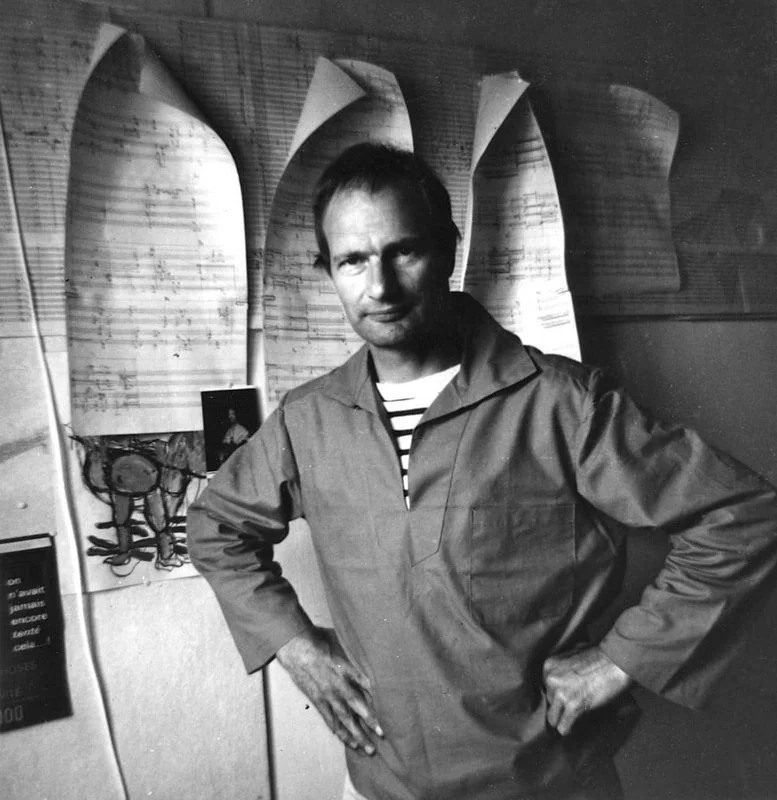
`There's Simeon ten Holt and then there's all the rest,' the composer of works including Canto Ostinato, Horizon and Lemniscaat once said jokingly of his position in Dutch musical life. Even today, one could say that, in a certain sense, this is still true. Anyone challenging a select group of contemporary music lovers to a fiery debate need mention only one name: that of Simeon ten Holt (b. 1923). In the late 1970s, this Dutch composer provoked the wrath of countless musical know-alls by returning to sounds that every ear could understand. He had the courage to abandon the complex, twelve-tone scores of the post-war era, which he traded in for simple triads, shifting rhythmic patterns and repeat signs. Completely independent of American composers like Steve Reich and Philip Glass, Ten Holt created a Dutch version of minimal music. Although Ten Holt deviated from the American approach by placing more importance on process than on technique and by taking an interest in the social interaction that occurs (in the case of several musicians) and the `liberation of the musical object', the listener need not be aware of this to appreciate his music. The music that was and still is denounced by the diehards of the serial school as `insipid cult music' and fatal, new simplicity became the new music that spoke to the experience of an ever-growing audience.
For Ten Holt, the road to apparent simplicity was anything but simple. He began as a true disciple of Jakob van Domselaer, his teacher, and was just as strict in applying the principles of the angular tonality that Van Domselaer displayed in his Proeven van Stijlkunst (Excercises in style) and just as inflexible in relation to other techniques. "Not only was Van Domselaer my teacher, he was also a nemesis", Ten Holt once said of him. "I had to free myself from him to be able to spread my own wings." Notwithstanding his quasi-orderly compositions, the anarchist streak Ten Holt had always had soon asserted itself. With his own `diagonal notion', based on the simultaneous sounding of tonalities a tritone apart, he stubbornly broke new ground for the first time in the mid 1950s and surprised audiences with slightly torsional structures like Soloduiveldans 1(1959) for piano.Ten Holt would rather not be reminded that, shortly after this voyage of discovery, he briefly conformed to the rules of serialism fashionable at the time, although his experience with electronic music during this period was invaluable to his later compositions it also played a role in arousing his interest in purely musical processes and he tired of `composing in [his] head, seated at the table, from the intellect and not from emotion'.
Once again, Ten Holt seemed averse to the most important influences around him and he dared to return to tonality. "While its true that I make use of traditional harmony, I have freed the elements of tension and relaxation so characteristic of it and have turned these into musical objects. Although the listener hears recognizable chords, these do not follow a conventional musical route because they have been isolated." His development of `tonality after the death of tonality' has made him a composer as celebrated as he is solitary. His first large work in his new language, Canto Ostinato (1976-1979) for keyboard instruments, put him on the map of Dutch music and managed to provoke the entire musical avant garde.
The imperturbability with which Ten Holt used Canto Ostinato as a model for all his subsequent compositions is remarkable and has earned him the unofficial title of the `most recognizable composer in the Netherlands'.
Although he uses familiar consonances, he has rejected the old laws of harmony. The basis of all his work is a sound pattern with a highly distinctive melodic and rhythmic character and a clearly defined tonal centre which can fill one or more measures. Ten Holt employs overlapping, repeating structures to imbue this `musical object' with a life all its own. "The repetitive procedure is intended to create the conditions in which the musical object can affirm its independence", he said of Canto Ostinato. In this respect, the performers have enormous freedom and, within certain limits, may determine their own work. Consequently, the length of the piece can vary to some extent and, because of the `social process' which Ten Holt believes constitutes music-making, can often take on extraordinary proportions. Lemniscaat for keyboard instruments (1983), for instance, took thirty hours to premiere.
With these works for several keyboard instruments, to which Horizon (1983-1985) and the more recent and chromatically coloured Meandres (1995-1997) belong, Ten Holt created his own world in which he gave musical shape to his ideas of time and space. "Time becomes space in which the musical object will float", he said cryptically in the summary notes to Lemniscaat.In the Soloduiveldansen 11, lll and I V - written in 1986, 1990 and 1996 respectively - he transferred his repetition and selection procedures explicitly to one keyboard instrument: his beloved piano. And despite its thinner texture, this piece hardly differs from the works scored for larger groups. Ten Holt also searches for the inner workings of the sound of a motive in the Soloduiveldansen. However important time may. be, he has focused all his efforts on eliminating the experience of time and on letting the musical `object' speak for itself. Naturally, the repetitive patterns are ideal background music for cleaning the house or the perfect accompaniment to the most blissful daydreams. However, listeners who make an effort to follow actively the shifting elements Ten Holt employs, his playing with fore- and background and the sudden introduction of new material will experience unprecedented adventures with musical means that, until now, were so well known. Listeners who can muster the concentration to listen in a truly intense way will be as surprised as the composer himself by unsuspected tonal relationships and melodic manifestations.
Simeon ten Holt’s experience as a composer covers the entire gamut from vilification to celebration. Since Canto Ostinato, he has devoted himself to composing an oeuvre unique in the world of Dutch composition. Although his oeuvre has apparently spawned no school or tolerated the slightest imitation, one must not underestimate his influence. Ten Holt has dedicated much of his life to redefining the beauty of the triad and other, related tonal means. He single-handedly cleared the way for many composers employing tonal elements today, a fact that will likely become fully evident only several decades from now. (PauI Janssen)
-
Sidney Hopson is an orchestral, studio, and solo percussionist from Los Angeles, CA. He performs frequently with the Jacaranda Chamber Ensemble, Los Angeles Master Chorale, Opera Santa Barbara, Southeast Symphony, West LA Symphony, and musicians of the LA Phil, LA Opera, and London Symphony Orchestras. He has premiered chamber works of John Williams, Philip Glass, John Adams, John Corigliano, Steve Reich, Peter Eötvös, and Kaija Saariaho. Sidney currently serves as director of percussion at the California State Summer School for the Arts, hosted by the California Institute of the Arts. He is also on faculty at the Young Musicians Foundation in Los Angeles, CA. Since 2009, Hopson has served as a freelance cultural policy analyst. As such, he has consulted hundreds of artists and institutions nationwide on progressive methods of financial, social, and infrastructural capital development. In 2013, he accepted the post of vice president of cultural development for Gigantic Worx.
-
Improviser, composer, and interpreter Tim Feeney seeks to explore and examine the possibilities inherent in unstable sound and duration. Tim began working in this thread in 2002, within Boston’s community of improvisers interested in austere combinations of sounds and silences, and has since performed and recorded with musicians throughout the United States and abroad. He frequently collaborates with artists including the trio Meridian, with percussionists Sarah Hennies and Greg Stuart, pianist Annie Lewandowski, cellist and electronic musician Vic Rawlings, vocalist Ken Ueno, saxophonist Andrew Raffo Dewar, banjo and electronic musician Holland Hopson, trumpeter Nate Wooley, sound artists Jed Speare and Ernst Karel, video artist Jane Cassidy, and many others.
He has presented work at experimental spaces throughout the United States, such as the Red Room in Baltimore, Boston’s Institute of Contemporary Art, the Knitting Factory New York, and The Stone, as well as the Center for New Music and Audio Technology at UC-Berkeley, the Stanford Art Museum, Princeton University, and Dartmouth College. Within this community, he has recorded for the experimental Caduc, Accidie, Rhizome.s, Full Spectrum, Sedimental, homophoni, Audiobot, Soul on Rice, lildiscs, and Brassland/Talitres labels.
Tim also builds sound installations, concerned primarily with the acoustic properties and geographies of neglected or nontraditional spaces. His recent work has been presented by festivals at locations including Silo City, the abandoned grain complex along the Buffalo River in western New York, Boston’s Metropolitan Waterworks Museum, the preserved steam pumping station that processed the city’s drinking water, and the Bernheim Research Forest, outside Louisville, Kentucky, as well as by more formal events at the Contemporary Art Center New Orleans and the University of Richmond.
-
Described as “phenomenal and fearless” Vicki Ray is a pianist, improviser and composer. She has commissioned and premiered countless new works by today’s leading composers. Ray is a founding member of Piano Spheres and was, for many years, the head of keyboard studies at the California Institute of the Arts where she was named the first recipient of the Hal Blaine Chair in Musical Performance. She has appeared on numerous international festivals and was a regular member of the faculty at the Bang On a Can Summer Festival at MASS MoCA. Ray has been featured on the Los Angeles Philharmonic Green Umbrella Series as soloist and collaborative artist. Her widely varied performing and recording career covers the gamut of new and old music: from Boulez to Reich, Wadada Leo Smith to Beethoven. Notable recordings include the first Canadian disc of Schoenberg’s Pierrot Lunaire with the Blue Rider Ensemble, the premiere recordings of Steve Reich’s You Are (Variations) and the Daniel Variations with the Los Angeles Master Chorale and the first recording of John Cage’s Europeras 3 and 4. Her recording of Cage’s The Ten Thousand Things on Microfest Records received a 2013 Grammy nomination. Vicki can also be seen playing the chromelodeon in the Los Angeles based PARTCH ensemble. Vicki Ray is a Steinway artist.
-
Acclaimed for her “commanding technique, color, and imagination” (The New York Times), Gloria Cheng has long been recognized as a leading champion of new music. Throughout her distinguished career, she has served as a muse to composers across a wide stylistic spectrum, premiering works by John Adams, Thomas Adès, Pierre Boulez, Anthony Davis, Terry Riley, Esa-Pekka Salonen, John Williams, and many others.
Gloria has appeared as a soloist with the Los Angeles Philharmonic under Boulez and Zubin Mehta, and on the orchestra’s Green Umbrella series under Salonen, Oliver Knussen, and Elim Chan. She has been a recitalist at the Ojai, Other Minds, William Kapell, and Tanglewood Festivals, and as a core artist on the Los Angeles-based Piano Spheres series.
Her extensive premieres and dedications include John Williams’ Prelude and Scherzo for Piano and Orchestra, written for her and Lang Lang; Salonen’s Dichotomie; and Boulez’s Courtes dérives à partir d’Éclat. John Adams composed the 2-piano work Hallelujah Junction for her and Grant Gershon, and Gloria commissioned Thomas Adès’s 2-piano arrangement of Powder Her Face and premiered it with the composer. Winner of the Best Instrumental Soloist Performance GRAMMY for her 2008 recording, Piano Music of Salonen, Stucky, and Lutosławski, she received a second nomination for her 2013 album, The Edge of Light: Messiaen | Saariaho.
Gloria’s projects often center on collaborations with eminent composers working beyond their customary creative horizons. For MONTAGE: Great Film Composers and the Piano, she enlisted six film composers whom she commissioned, recorded, and featured in a documentary that earned a 2018 Emmy for Independent Programming. Similarly, Gloria commissioned six distinguished jazz improvisers to compose fully-notated solo works for her 2025 album, Root Progressions. Gloria is noted for imaginative programming spanning Adès to Zappa, including duo recitals with Adès, Riley, and recent Boulez centennial performances with acclaimed Dutch pianist Ralph van Raat.
She is a Distinguished Adjunct Professor at the UCLA Herb Alpert School of Music.
-
Jonathan Hepfer is a percussionist, conductor, and concert curator. He began playing classical music at age seventeen after discovering the work of John Cage while studying at SUNY Buffalo. Subsequently, Jonathan attended Oberlin Conservatory, UC San Diego and the Musikhochschule Freiburg (on a DAAD fellowship) where he studied with Michael Rosen, Steven Schick and Bernhard Wulff.
Since 2015, he has been the Artistic Director of Monday Evening Concerts (MEC) in Los Angeles as well as its resident ensemble ECHOI. At MEC, Jonathan has directed performances of major works by Pierre Boulez, John Cage, Julius Eastman, Morton Feldman, Philip Glass, Gérard Grisey, Sarah Hennies, Yves Klein, Arvo Pärt, Steve Reich, Salvatore Sciarrino, Caroline Shaw, Tyshawn Sorey, Simeon Ten Holt and Iannis Xenakis.
As a curator and producer, he has presented works by Georges Aperghis, Pierluigi Billone, Carolyn Chen, Chaya Czernowin, Julius Eastman, David Hammons, Sarah Hennies, György Kurtág, Klaus Lang, Alvin Lucier, Hans Otte, Éliane Radigue, Michael Pisaro-Liu, Caroline Shaw, Wadada Leo Smith, Steven Takasugi, Davóne Tines and Wu Tsang.
Jonathan has directed (or co-directed) projects at venues such as the Getty Museum, Harvard University, Hauser & Wirth, Jeffrey Deitch, LACMA, LAXART, Marciano Art Foundation, the Santa Monica Carousel (Frieze), Thomas Mann House and the Pinault Collection in Paris.
As a percussion soloist, Jonathan has focused extensively on the works of Georges Aperghis, Pierluigi Billone, Julius Eastman, Brian Ferneyhough, Morton Feldman, Vinko Globokar, Helmut Lachenmann, Giacinto Scelsi, Iannis Xenakis and Walter Zimmermann. In this capacity, he has performed widely across the United States, Europe and Asia.
Recent independent projects have included serving as artistic director for a portrait of Julius Eastman at the Pinault Collection in Paris (a collaboration with Anaïs Ngbanzo, Dev Hynes and Adam Tendler) and performing the role of conductor in a revival of Deborah Hay's 'Solo 2' at the Getty Museum. Jonathan has also contributed to projects by friends such as Henrik Purienne ('Tasjaki' at Galerie Chenel), Vanessa Beecroft and Gustave Rudman ('Two Shadows' at Jeffrey Deitch) and Henri Levy Alexandre (Enfants Riches Déprimés S/S '25).
He has published interviews with Meredith Monk (Autre Magazine), Éliane Radigue (Purple Magazine) and Steve Reich (Kaleidoscope Magazine). Jonathan also documented the oral histories of the pioneering generation of percussion soloists (Jan Williams, Christoph Caskel, Sylvio Gualda, Jean-Pierre Drouet, Gaston Sylvestre, Maurizio Ben Omar).
Jonathan has served on the faculty at Art Center Pasadena and Cal Arts. He is interested in the ways that music intersects with visual art, literature, architecture, fashion and film.